

- ISO 17025 laboratories requiring CRM
- Validation/verification of processes and instruments
- Presence/Absence
- Identification methods
-

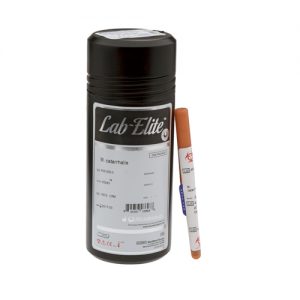 Qualitative control strains as Certified Reference Material for ISO 17025 accredited labs Increasing regulatory oversight in food, pharmaceutical and water industries has prompted many microbiology labs to seek accreditation to ISO 17025 standards. The Lab-Elite CRM, from Microbiologics®, is designed to help those labs meet the requirements of this standard which specify that “reference materials shall, where possible, be traceable to SI units of measurements, or to Certified Reference Materials (section 5.6.3.2)”. Lab-Elite CRM microorganisms are just one passage from the reference culture and are delivered in our signature KWIK-STIK format. As a Certified Reference Material, Lab-Elite comes with a comprehensive Certificate of Analysis detailing the strains identity and characteristics. Applications & Test Methods
 -
 Qualitative control strains for QC testing It doesn’t get much easier than the LYFO-DISK from Microbiologics®. Simply rehydrate LYFO DISK qualitative microorganism pellets with a diluent, such as phosphate buffer or saline, and you’re ready to inoculate your culture media. LYFO DISK, packaged in a glass vial containing 6 pellets of a single strain, offers a ton of flexibility. It's an ideal solution for many quality control applications including presence/absence testing, microbial identification methods, antimicrobial susceptibility testing, media QC, water testing and more! Applications & Test Methods
- Culture Purposes
- Media and reagent QC
- QC of Antimicrobial Susceptibility Test
- QC of microbial identification including biochemical, PCR and rapid molecular methods
- Water tests (e.g. enzyme substrates)
- Disinfectant studies
- Verifications and Validations
- Proficiency tests
- Daily QC
-
 QC microorganisms with Green Fluorescent Protein (GFP) markers It’s not uncommon for food samples to inadvertently become contaminated with control strains used in the laboratory. This leads to false-positive results which can have severe financial and regulatory implications. UV-BioTAG, our line of reference strains containing green fluorescent protein (GFP) markers, make it easy to distinguish standard microorganism strains from laboratory control strains. Optimised for highly visible fluorescence, UV-BioTAG strains provide better stability because the GFP marker is integrated into the chromosome rather than the plasmid. With UV-BioTAG, you can quickly and reliably establish whether a positive test result can be traced back to a control strain cross-contamination issue, or if it is from another source. Applications & Test Methods
- Enumeration Methods
- Detection Methods
- Demonstration of Capability (DOC)
- Media QC
- Validation/Verification
-

 Biolog Solutions for Microbiome Analysis Introducing The PreBioM™ line of microplates. The microplates allow researchers studying human or animal gut microbiome communities to better understand metabolism of prebiotics. PreBioM plates offer a multidimensional phenotype profiling solution based on the impact of prebiotics on microbial function. The three-plate system contains 90 unique prebiotic substrates tailored to investigate the intricate interplay between prebiotics and the microbiome. These plates consist of a curated selection of prebiotic substrates of various molecular weights designed to characterise bacterial species and their metabolic pathways. The PreBioM plates, combined with the Biolog Odin family of instruments and software, provide a high throughput phenotypic solution compatible with a wide range of species, including the obligate anaerobes inhabiting the gut microbiome as well as microbial communities.
 -

 Solid Phase Cytometry meets Artificial Intelligence TECHNOPATH partners with Microbs for their fully automated solution. To boost productivity in your microbial QC lab, Microbs launches IAN®, an Ultra Rapid Microbiological Method allowing an accurate enumeration of bacteria, yeast and mould within minutes, not days! With IAN®, you can redesign your quality control. No need to wait days to check the microbiological quality of your production. IAN® gives you a quantitative measurement of your contamination in 15 minutes using our innovative direct non-growth detection method.
- Mobile Laboratory - Autonomous, its fits where you need it.
- Speed - Time to result: 15 minutes, no enrichment needed.
- Simplicity - No expertise required
- Accuracy - Detection range from 1 to ≈ 5 000 microorganisms/volume analysed
- Liquid sample - Sampling from 100µL to 200mL
- Traceability - Full Data integrity, 21 CFR 11 compliant
-

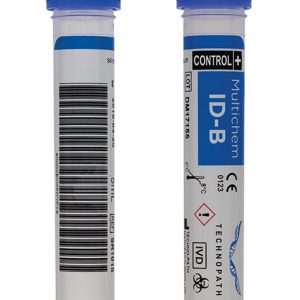 Positive multi-marker QC Multichem Infectious Disease (ID) Quality Controls (QC) samples, have been specifically optimised and validated to match assays commonly used for infectious diseases testing. Multichem ID-B is an unassayed control, optimised for Abbott and Diasorin instruments. Scroll down to view the product benefits and analyte list. The Multichem ID Multi-marker range of products is easily identifiable by their colour coding (in this case B for blue). Multichem ID-B consolidates six analytes (see analyte list below). This unassayed product is optimised for specific platforms, including; Abbott Architect, Abbott Alinity i, Abbott Alinity s, DiaSorin Liaison, DiaSorin Liaison XL MUREX.
 -
 Positive quality control for antibodies to SARS-CoV-2 (including IgG) Multichem ID-COVID19 G is an unasssayed third-party quality control for Antibodies to SARS-CoV-2 (including IgG). This Quality Control is available with access to the Technopath Clinical Diagnostics inter-laboratory Peer program, IAMQC®. The Multichem ID-COVID19 G (unassayed) is a positive control for antibodies to the SARS-CoV-2 virus (including IgG). The kit is delivered in a choice of two configurations: 4x2mL tubes with an integrated instrument barcode and secondly 4 x 4mL vials. The product is suitable for use on all major platforms, including amongst others, Abbott, Roche and Siemens. All Multichem ID-COVID19 quality controls are supported by the inter-laboratory Peer program - IAMQC®.
 -
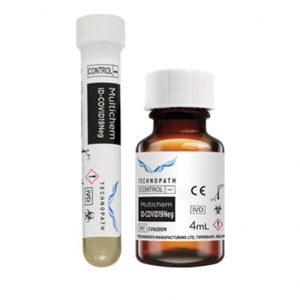 Negative quality control for antibodies to SARS-CoV-2 (including IgG) Multichem ID-COVID19Neg is an unassayed negative third-party quality control for antibodies to SARS-CoV-2 (including IgG). This Quality Control is available with access to the Technopath Clinical Diagnostics inter-laboratory Peer program, IAMQC®. The Multichem ID-COVID19Neg (unassayed) is an unassayed negative third-party quality control for antibodies to SARS-CoV-2 (including IgG). The kit is delivered in a choice of two configurations: 4x2mL tubes with an integrated instrument barcode and secondly 4 x 4mL vials. The product is suitable for use on all major platforms, including amongst others, Abbott, Roche and Siemens. All Multichem ID-COVID19 quality controls are supported by the inter-laboratory Peer program - IAMQC®.
 -
 Negative multi-marker QC Multichem Infectious Disease (ID) Quality Controls (QC) samples, have been specifically optimised and validated to match assays commonly used for infectious diseases testing. Multichem ID-SeroNeg provides a negative control for the analytes listed below. Scroll down to view the product benefits and analyte list. Multichem ID SeroNeg provides a third party, unassayed, negative control for commonly tested assays for anti-HIV, anti-HCV, anti HTLV, anti-HBc, anti-Treponema, HBsAg and HIVp24
 -
 Multichem A1c Control, from Technopath Manufacturing Ltd, is intended for use as a third party, bi- level, liquid stable quality control material to monitor the precision of laboratory testing procedures for Haemoglobin A1c determination Assays. The intended patient population are those with diabetes. The haemoglobin A1c test, also called HbA1c, glycated haemoglobin test, or glycol-haemoglobin, is an important blood test that shows how well a patient’s diabetes is being controlled. Multichem A1c Control is designed as a bi-level, liquid stable frozen product. The product will typically be run after reagent calibration and at a frequency dictated by laboratory QC procedures and reagent / instrument manufacturer instructions. The product should be treated the same as patient specimens and run in accordance with the instructions accompanying the instrument, kit or reagent being used. The control is to be stored at -20°C to –80°C and thawed as per IFU prior to use. The product is to be stored at 2 to 8°C between use.
 -
 Multichem AE (Ammonia Ethanol) Control, from Technopath Manufacturing Ltd, is intended for use as a third party liquid stable quality control material to monitor the precision of laboratory testing procedures for Ammonia and Ethanol Assays. Multichem AE Control is designed as a liquid stable frozen product. The product will typically be run after reagent calibration and at a frequency dictated by laboratory QC procedures and reagent / instrument manufacturer instructions. The product should be treated the same as patient specimens and run in accordance with the instructions accompanying the instrument, kit or reagent being used. The control is to be stored at -20°C to –80°C and thawed as per IFU prior to use. The product is to be stored at 2 to 8°C between use.
 -

 Multichem AMH Control, from Technopath Manufacturing Ltd, is intended for use as a third party, tri-level, liquid stable quality control material to monitor the precision of laboratory testing procedures for Anti Mullerian Hormone Assays. The product will typically be run to provide a minimum of 2 levels of control to monitor AMH assay performance within the analytical ranges. Multichem AMH Control will be run after reagent calibration and at a frequency dictated by laboratory QC procedures and reagent / instrument manufacturer instructions. The product should be treated the same as patient specimens and run in accordance with the instructions accompanying the instrument, kit or reagent being used. The Control is to be stored at -20°C to –80°C and thawed as per IFU prior to use. The product is to be stored at 2 to 8°C between use.
 -

 Third party, bi-level, liquid stable, multi-analyte quality control material to monitor the precision of laboratory testing procedures for Cerebral Spinal Fluid Assays. Multichem CSF, from Technopath Manufacturing Ltd, contains 4 analytes including CSF glucose, protein, IgG and lactate. Multichem CSF Controls are designed as bi-level, liquid stable frozen products. These products will typically be run after reagent calibration and at a frequency dictated by laboratory QC procedures and reagent / instrument manufacturer instructions. The products should be treated the same as patient specimens and run in accordance with the instructions accompanying the instrument, kit or reagent being used. The controls are should be stored at -20°C to -80°C and thawed as per IFU prior to use. The products should be stored at 2 to 8°C between use.
 -

 Multichem D-Dimer Control, from Technopath Manufacturing Ltd, is intended for use as a third party, bi-level, liquid stable quality control material to monitor the precision of laboratory testing procedures for D-Dimer Assays. Multichem D-Dimer Control is intended for use as a third party, bi-level, liquid stable quality control material to monitor the precision of laboratory testing procedures for D-Dimer Assays. Multichem D-Dimer Control is designed as a bi-level, liquid stable frozen product. The product will typically be run to provide a minimum of two levels of control to monitor D-Dimer assay performance within the analytical ranges. Multichem D-Dimer Control will be run after reagent calibration and at a frequency dictated by laboratory QC procedures and reagent / instrument manufacturer instructions. The product should be treated the same as patient specimens and run in accordance with the instructions accompanying the instrument, kit or reagent being used. The Control is to be stored at -20°C to -80°C and thawed as per IFU prior to use. The product is to be stored at 2 to 8°C between use.
 -
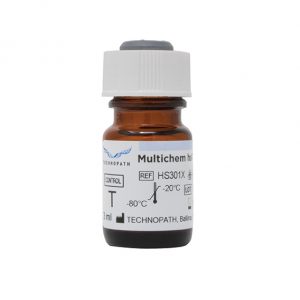 Multichem hsTn Control, from Technopath Manufacturing Ltd, is intended for use as a third party, single level, liquid stable quality control material to monitor the precision of laboratory testing procedures for high sensitive Troponin Assays. The intended patient population is Cardiac patients, where a requirement has been identified for testing conditions associated with elevated levels of Troponin I and Troponin T. Multichem hsTn Control is designed as a single level, liquid stable frozen product. The product will typically be run as a low level/high sensitive control, in conjunction with one other level of the Multichem IA / Multichem IA Plus series of serum controls for the same analytes, after reagent calibration and at a frequency dictated by laboratory QC procedures and reagent / instrument manufacturer instructions. This product design is based on the existing Multichem IA Plus L1 control, but incorporating the required features of a single low level Troponin Control, to supplement the IA Plus Control to monitor the precision of Troponin assay methods, at the low end of the linear dynamic range. The product should be treated the same as patient specimens and run in accordance with the instructions accompanying the instrument, kit or reagent being used. The control is to be stored at -20°C to –80°C and thawed as per IFU prior to use. The product is to be stored at 2 to 8°C between use.
 -
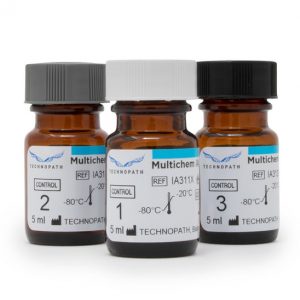
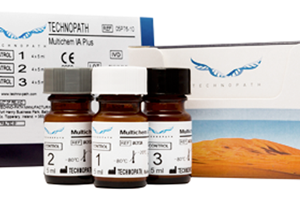 Multichem IA contains 83 analytes including fertility and thyroid hormones, steroid hormones, cardiac markers, anaemia markers, therapeutic drugs, adrenal markers and bone metabolism markers. Multichem IA Control, from Technopath Manufacturing Ltd, is intended for use as a third party, multi-constituent quality control material to monitor the precision of laboratory testing procedures for Immunoassay Assays. Please note: the main difference between Multichem IA Plus and Multichem IA product is the addition of three tumor markers to Multichem IA Plus; CA 125, CA 15-3 and CA 19-9. Multichem IA is designed as a tri-level, liquid stable frozen product. This product will typically be run after reagent calibration and at a frequency dictated by laboratory QC procedures and reagent / instrument manufacturer instructions. The product should be treated the same as patient specimens and run in accordance with the instructions accompanying the instrument, kit or reagent being used. The control should be stored at -20°C to –80°C and thawed as per IFU prior to use. The product should be stored at 2 to 8°C between use.
 -
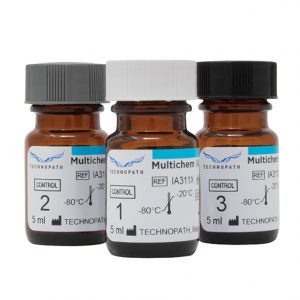 Multichem IA Plus Control is intended for use as a third party, multi-constituent quality control material to monitor the precision of laboratory testing procedures for Immunoassay Assays. Multichem IA Plus contains 86 analytes including fertility and thyroid hormones, steroid hormones, cardiac markers, anaemia markers, therapeutic drugs, adrenal markers, bone metabolism markers and tumour markers. Multichem IA Plus, from Technopath Manufacturing Ltd, is designed as a tri-level, liquid stable frozen product. This product will typically be run after reagent calibration and at a frequency dictated by laboratory QC procedures and reagent / instrument manufacturer instructions. The product should be treated the same as patient specimens and run in accordance with the instructions accompanying the instrument, kit or reagent being used. The control should be stored at -20°C to –80°C and thawed as per IFU prior to use. The product should be stored at 2 to 8°C between use.
 -
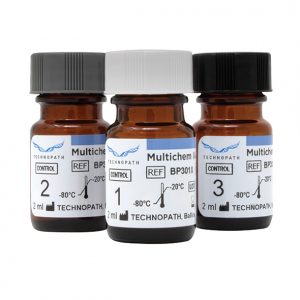 Multichem IA Speciality Immunoassay Controls are intended for use as third party, tri- level, liquid stable, multi-analyte quality control materials to monitor the precision of laboratory testing procedures for Immunoassay Assays. Multichem IA Speciality, from Technopath Manufacturing Ltd, is designed to complement Multichem IA and Multichem IA Plus Immunoassay Controls by offering significantly increased stability for BNP, PTH and ACTH. In addition to these analytes, Multichem IA Speciality Controls also contains and provides tri level utility for Procalcitonin and Calcitonin. Multichem IA Speciality Immunoassay Controls are designed as tri-level, liquid stable frozen products. These products will typically be run after reagent calibration and at a frequency dictated by laboratory QC procedures and reagent / instrument manufacturer instructions. The products should be treated the same as patient specimens and run in accordance with the instructions accompanying the instrument, kit or reagent being used. The controls should be stored at -20°C to –80°C and thawed as per IFU prior to use. The products should be stored at 2 to 8°C between use.
 -
 Third party, single elevated level, liquid stable quality control material to monitor the precision of laboratory testing procedures for Bilirubin and Theophylline Assays. Multichem NB (Neonatal Bilirubin) Control, from Technopath Manufacturing Ltd, is intended for use as a third party, single level, liquid stable quality control material to monitor the precision of laboratory testing procedures for Bilirubin and Theophylline Assays. An important patient population is Neonates, where a requirement has been identified for testing conditions associated with Neonatal hyperbilirubinemia. The product also contains Theophylline, a therapeutic drug that is given to Neonates to improve lung capacity and where it would be required to monitor for toxicity risk. Caffeine is a listed analyte that is added gravimetrically, and this has a clinical function as the primary treatment of the breathing disorders apnea of prematurity. Another important population is with any patient that has liver failure. It is important if the laboratory tests hyperbilirubinemia patient samples that they analyze QC regularly to monitor this range to ensure accuracy and precision at these elevated levels. The requirement for a high concentration of Bilirubin presents a conflict for consolidation of multi-analytes. This means that not only is a separate paediatric control required, but a control matrix that is treated with antioxidants to inhibit the oxidation of Bilirubin. The application of the most appropriate measures to reduce the effect of oxidation on the high levels of Bilirubin in the Control have been researched to ensure that open vial and closed stability is maintained. Multichem NB Control is designed as a single level, liquid stable frozen product. The product will typically be run as a supplementary high level control, in conjunction with at least one of the Multichem Serum Control levels, (S or S Plus) to provide a minimum of 2 levels of control to allow assay system performance monitoring within the analytical ranges. It will be run after reagent calibration and at a frequency dictated by laboratory QC procedures and reagent / instrument manufacturer instructions. The product should be treated the same as patient specimens and run in accordance with the instructions accompanying the instrument, kit or reagent being used. The control is to be stored at -20°C to –80°C and thawed as per IFU prior to use. The product is to be stored at 2 to 8°C between use.
 -
 Multichem P (P for protein), from Technopath Manufacturing Ltd, is specifically designed as a supplementary QC product for immunoproteins to be used in conjunction with the Multichem clinical chemistry QC. This product offers elevated concentrations for immunoprotein. Users can use this in conjunction with 1, 2 or 3 levels of Multichem S Plus or Multichem S, each of which already include multiple concentrations for immunoproteins. The full list of products available are shown below. Multichem P Supplementary Immunoprotein Control is intended for use as a third party, single level, liquid stable immunoprotein quality control material to monitor the precision of laboratory testing procedures for Immunoprotein Assays. Target values are provided for 39 analytes, including immunoglobulins, complement proteins, inflammatory proteins as well as carrier and storage proteins. The product will typically be run as a supplementary high level control, in conjunction with at least one of the Multichem Serum Control levels, (S or S Plus) to provide a minimum of 2 levels of control to allow assay system performance monitoring within the analytical ranges. It will be run after reagent calibration and at a frequency dictated by laboratory QC procedures and reagent / instrument manufacturer instructions. The product should be treated the same as patient specimens and run in accordance with the instructions accompanying the instrument, kit or reagent being used. The control is to be stored at -20°C to –80°C and thawed as per IFU prior to use. The product is to be stored at 2 to 8°C between use.
 -
 Multichem S Control, from Technopath Manufacturing Ltd, is intended for use as third party, tri- level, liquid stable, multi-analyte quality control materials to monitor the precision of laboratory testing procedures for Chemistry and Immunology assays. Multichem S contains 101 analytes (does not include the addition of CRP and RF, which are available in Multichem S Plus) Multichem S Control is designed as a liquid stable frozen product. The product will typically be run after reagent calibration and at a frequency dictated by laboratory QC procedures and reagent / instrument manufacturer instructions. The product should be treated the same as patient specimens and run in accordance with the instructions accompanying the instrument, kit or reagent being used. The control should be stored at -20°C to –80°C and thawed as per IFU prior to use. The product should be stored at 2 to 8°C between use.
 -
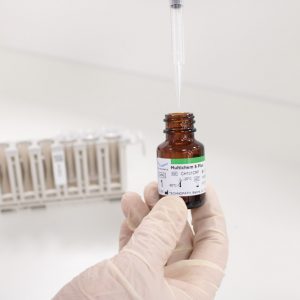
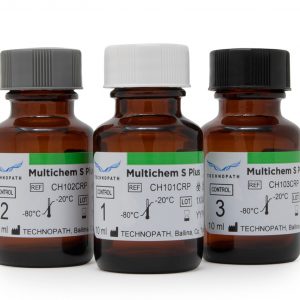 Multichem S Plus Control, from Technopath Manufacturing Ltd, is intended for use as a third party, multi-constituent quality control material to monitor the precision of laboratory testing procedures for Chemistry Assays. It incorporates serum chemistry, immunology, lipid, TDM, enzymes and esoterics. Multichem S Plus contains 105 analytes including the addition of C-Reactive Protein and Rheumatoid Factor at clinically relevant concentrations. Chemistry, Esoterics, Immunoproteins, Enzymes, Lipids, and Therapeutic Drugs are also included. When combined with Multichem P the solution offers an extensive spread of immunoprotein concentrations. Multichem S is also available, please note that Multichem S contains all the same analytes apart from C-Reactive Protein and Rhematoid Factor. Multichem S Plus is designed as a tri-level, liquid stable frozen product. This product will typically be run after reagent calibration and at a frequency dictated by laboratory QC procedures and reagent / instrument manufacturer instructions. The product should be treated the same as patient specimens and run in accordance with the instructions accompanying the instrument, kit or reagent being used. The control should be stored at -20°C to –80°C and thawed as per IFU prior to use. The product should be stored at 2 to 8°C between use.
 -
 Multichem U Control, from Technopath Manufacturing Ltd, is intended for use as a third party, bi- level, liquid stable, multi-analyte control designed for use in the routine monitoring of precision of laboratory testing procedures. Target values are provided for 13 analytes including kidney function parameters, pituitary/adrenal metabolites, hCG and urinary proteins. Multichem U Control is designed as a bi-level liquid stable product. The product will typically be run after reagent calibration and at a frequency dictated by laboratory QC procedures and reagent / instrument manufacturer instructions. The product should be treated the same as patient specimens and run in accordance with the instructions accompanying the instrument, kit or reagent being used. The control is to be stored at 2°C to 8°C and mixed as per IFU prior to use. The control is to be stored at 2 to 8°C between use.
 -
 Multichem WBT Control, from Technopath Manufacturing Ltd, is intended for use as a third-party, tri- level, liquid stable quality control material to monitor the precision of laboratory testing procedures for Cyclosporine, Tacrolimus and Sirolimus Assays. Multichem WBT Control is designed as a tri-level, liquid stable frozen product. The product will typically be run after reagent calibration and at a frequency dictated by laboratory QC procedures and reagent / instrument manufacturer instructions. The product should be treated the same as patient specimens and run in accordance with the instructions accompanying the instrument, kit or reagent being used. The control is to be stored at -20°C to –80°C and thawed as per IFU prior to use. The product is to be stored at 2 to 8°C between use.
 -

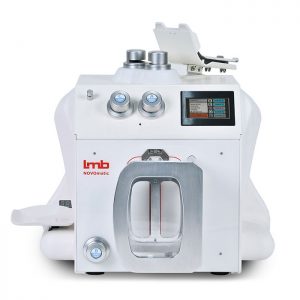 Precise separation of blood components The NOVOmatic from LMB is a supreme automatic blood separator with motor driven pressing plate and touch screen.
- Quick blood separation process
- High recovery of thrombocytes
- Precise treatment of all Top/Top and Top/Bottom processes
- CRYO application
- Thrombocytes from Buffy Coat and PRP
- Adaptive optical sensor system for best possible distinction between red cells and plasma
- Precise mechanics for long endurance
-

 Ensure pipettes are performing properly and operator skills are standardised Manage your pipette calibration program and assess operator competency. Used in combination with the Artel PCS, the PCS Software ensures your pipettes and their operators are working together to generate accurate and reproducible results. The PCS Software provides scheduling for pipette calibrations and interim performance verifications; complete documentation and pipette inventory management, even for pipettes calibrated outside of PCS Software – and it’s ideal for standardising pipetting technique and assessing operator competency.
 -
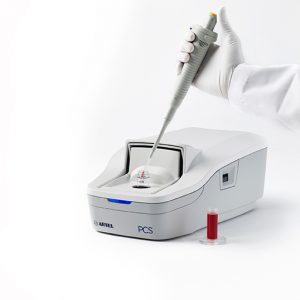 Ensure pipettes are performing properly and operator skills are standardized Manage your pipette calibration program and assess operator competency. Used in combination with the Artel PCS, the PCS Software ensures your pipettes and their operators are working together to generate accurate and reproducible results. The PCS Software provides scheduling for pipette calibrations and interim performance verifications; complete documentation and pipette inventory management, even for pipettes calibrated outside of PCS Software – and it’s ideal for standardising pipetting technique and assessing operator competency.
 -
Ensure pipettes are performing properly and operator skills are standardized Manage your pipette calibration program and assess operator competency. Used in combination with the Artel PCS, the PCS Software ensures your pipettes and their operators are working together to generate accurate and reproducible results. The PCS Software provides scheduling for pipette calibrations and interim performance verifications; complete documentation and pipette inventory management, even for pipettes calibrated outside of PCS Software – and it’s ideal for standardising pipetting technique and assessing operator competency.
-
 Transportation of blood and organs Introducing the Portable Refrigerators from LMB. Keeps your blood products and organs refrigerated during transportation. Various storage capacity for blood bags available according to your need.
 -
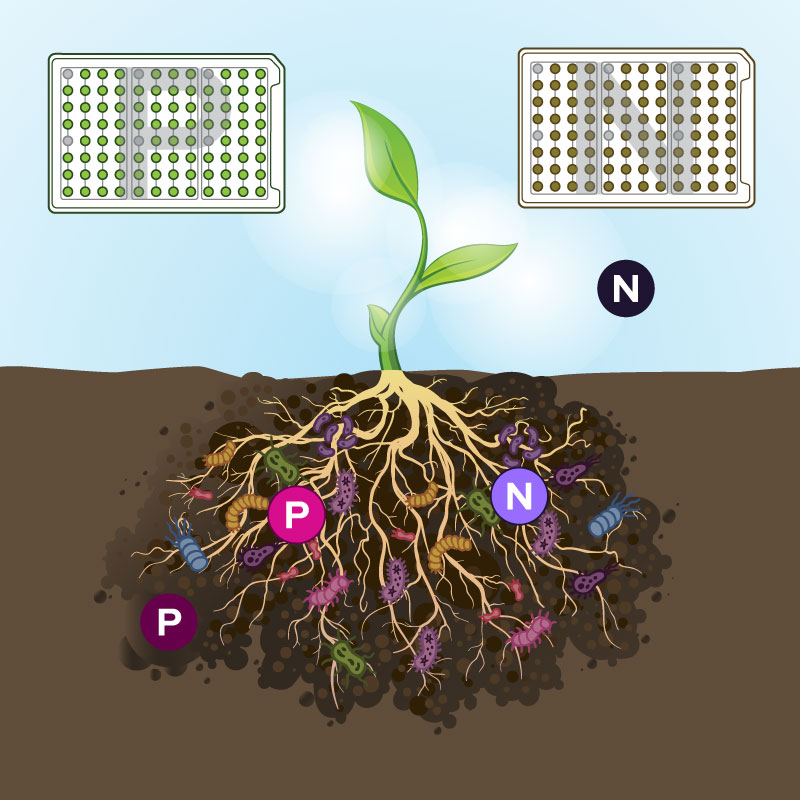 RhizoPlates™ Microbial Selection for Sustainable Agriculture The RhizoPlate™ series of microplates provides a targeted and easy-to-use solution for detecting, ranking, and monitoring nitrogen-fixing & phosphate-solubilising bacteria (NFB/PSB) within the rhizosphere.
 -
 CE Marked Routine Coagulation Controls from Biomedica Diagnostics are intended to be used as unassayed controls for monitoring the performance of routine coagulation assays on analysers in a clinical setting. The controls are to be tested in the same manner as freshly drawn citrated patient plasma. The controls are available within the normal and abnormal ranges and suitable for use in four (4) parameters.
 -

 For Laboratory, Milk Reception & Process Testing Bentley Instruments have designed devices to automate your milk samples preparation. Agiflex 270 - Homogenisation of samples before analysis Ideal for laboratory use when preparing samples before analysis, the Agiflex 270 is a compact device designed to homogenise all types of containers such as sample trays, racks, flasks and tubes. Adjustable rotation speed from 17 up to 52 rpm. Paraffin Dispenser The paraffin dispenser allows automatic dispensing of melted paraffin in vial or tube racks. Designed specifically to fit your containers, this dispenser is mainly composed of a set of automation and a customised trolley for carrying trays.
 -
 Introducing the Sorter Robot The sorter robot is used to sort the samples and placed them in trays of different colours, depending on the desired analytical chain. Refrigerated to maintain samples quality, it sorts up to 6 different criteria.
 -

 Newborn screening platform powered by digital microfluidics SEEKER® is a newborn screening laboratory solution that performs multiple assays at the same time using just one punch from a newborn dried blood spot specimen. SEEKER® is used to test thousands of babies each day around the world. Lysosomal Storage Disorders SEEKER® is the first FDA-authorised and CE-marked newborn screening platform for lysosomal storage disorders. SEEKER® quantitatively measures the activity of lysosomal enzymes from newborn dried blood spot specimens. Reduced activity of these enzymes may be indicative of: MPS I • Pompe • Gaucher • Fabry
 -
 Precise determination of somatic cell counts in all types of raw milk Semi-automatic and automatic versions from 100 up to 300 samples/hour The SomaCount FC delivers a rapid and accurate measurement somatic cell counts (SCC) for early mastitis detection in dairy milk. The smallest and most accurate instrument available for the counting of somatic cells in raw milk. Robust and reliable, it is used in both regulatory and high performing dairy laboratories around the globe. Flow cytometry at its best. For any laboratory where precision and performance is essential. It guarantees the accurate counting of somatic cells in milk at a maximum speed of 300 samples/hour (6 versions available: manual, 100, 150, 200, 250 and 300). The automatic SomaCount FC version is coupled to a conveyor system.
 -

 CE Marked Special Coagulation Controls from Biomedica Diagnostics are intended to be used as unassayed controls for monitoring the performance of special and routine coagulation assays on analyzers in a clinical setting. The controls are to be tested in the same manner as freshly drawn citrated patient plasma. The controls are available within the normal and abnormal ranges and suitable for use in eighteen (18) parameters.