-

 Introducing the SEALmatic range of Tube Sealers from LMB SEALmatic M - Outstanding standalone and segmenting tube sealer The INTELIGENT cooling system allows sSmart silent working mode during sealing. Fan will be turned ON only when temperature rises. Enjoy a noise friendly working environment with SEALmatic M. Individual units can be used in standalone mode or combined freely to make a segmenting device with high variety of segment sizes. It assures a high level of mobility within the donation room. SEALmatic H - Standalone tube sealer with handle SEALmatic P - Portable tube sealer with maximum flexibility With its appealing design, carrying band and low weight it offers a high level of mobility within the donation room or field work during mobile collections. SEALmatic C - Portable tube sealer for use with the Bagmatic NOVO LS SEALmatic C is specifically made to work in conjunction with Bagmatic NOVO or Bagmatic NOVO LS, making it a 2 in 1 device (tube sealer and blood mixer).
 -
 Separation of whole blood - two bag systems simultaneously on one device The Dualpress from LMB is a high quality device for whole blood separation. 6 Bag sensors on each side guarantee stable buffy coat level during separation. Touchscreen with easy menu navigation.
 -
 Precise separation of blood components The NOVOmatic from LMB is a supreme automatic blood separator with motor driven pressing plate and touch screen.
- Quick blood separation process
- High recovery of thrombocytes
- Precise treatment of all Top/Top and Top/Bottom processes
- CRYO application
- Thrombocytes from Buffy Coat and PRP
- Adaptive optical sensor system for best possible distinction between red cells and plasma
- Precise mechanics for long endurance
-
 Completely adaptable system for all applications The LUXOmatic from LMB is a premium blood separator for blood products of the highest quality. The dual press system allows for blood separation in two places at the same time.
- Quick blood separation bags and high recovery of thrombocytes
- Precise treatment of all Top/Top and Top/Bottom processes
- CRYO application
- Thrombocytes from Buffy Coat and PRP
- Adaptive optical sensor system for best possible distinction between red cells, thrombocytes and plasma
- Precise and durable mechanical system
-
 Space saver and adaptable system for individual applications The LUXOmatic V2 from LMB is a premium blood separator with motor driven plates, touch screen and integrated bar code scanner.
- Sophisticated motor driven blood separator
- Two independent separation places in one device – Saves working space, time and provides best economic benefit
- High quality of separated blood products
- Heavy duty industrial scale separations
- Paediatric bags extraction possibility
- Ergonomic design
-

 The ID Station™ system, together with our identification microplates, can identify a wide range of environmental and pathogenic organisms across diverse fields of microbiology. How it Works The ID Station™ system identifies a wide range of environmental and pathogenic organisms across diverse fields of microbiology. Nearly 3,000 species of bacteria, yeast and filamentous fungi can be identified by using Biolog’s identification microplates (GEN III, AN, YT, or FF) and database. Some bacteria can be identified in as little as 1 hour. Just prepare a cell suspension and inoculate the appropriate microplate. After inoculation and incubation, the microplate is placed into the ID Station for analysis. The unique metabolic pattern generated by the organism is recorded and compared to thousands of identification profiles in the Biolog database. The instrument takes optical density readings at two wavelengths to quantify color reactions consistently and accurately in the microplate wells. Biolog’s patented redox chemistry makes use of different carbon compounds including sugars, carboxylic acids, amino acids, and peptides to provide an unparalleled wealth of discriminating biochemical characterisations. This diverse set of tests enables our systems to identify microorganisms that other methods misidentify or fail to identify.
 -

 Tray 4x8 for Vials 60ml The Bentley Instruments tray is made of high-resistance ABS plastic (-18°C / +80°C) and identifiable by HF/LF RFID chips or barcode. It lets circulate water in a water bath, is stackable with fall blocking system and positions from 1 to 32 are indicated. Compatible with most vials (84 mm height max - diameter 36 mm max). Compatible with the ILAS 4000 Robot: Automation System for Bacteria Counter and the ILAS 3000 Robot: Automation System for Milk Analysers.
 -
 For Laboratory, Milk Reception & Process Testing Bentley Instruments have designed devices to automate your milk samples preparation. Agiflex 270 - Homogenisation of samples before analysis Ideal for laboratory use when preparing samples before analysis, the Agiflex 270 is a compact device designed to homogenise all types of containers such as sample trays, racks, flasks and tubes. Adjustable rotation speed from 17 up to 52 rpm. Paraffin Dispenser The paraffin dispenser allows automatic dispensing of melted paraffin in vial or tube racks. Designed specifically to fit your containers, this dispenser is mainly composed of a set of automation and a customised trolley for carrying trays.
 -
 Introducing the Capper Robot The capper robot is used to dispense the preservative and cap the vials up to a maximum speed of 2500 vials/hour. It can be equipped with an input/output stacker or a gravity roller depending on the space available.
 -
 Introducing the Sorter Robot The sorter robot is used to sort the samples and placed them in trays of different colours, depending on the desired analytical chain. Refrigerated to maintain samples quality, it sorts up to 6 different criteria.
 -
 Introducing the ILAS 4000 Robot The new ILAS 4000 robot is a unique solution to automate and standardise sample preparation for bacteria counters up to a maximum speed of 200 samples/hour. Fully refrigerated, samples are identified (RFID chips or barcode), homogenised, uncapped and analysed. The vials are automatically recapped after analysis and place back in their original tray position. Compatible with the BactoCount IBC Series: Bacteria & Somatic Cells Counter and alternative methods. The Standardisation Tray used for Laboratory Automation is compatible with the ILAS Robot.
 -
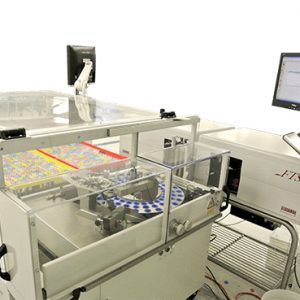 Introducing the ILAS 3000 Robot The combination of the Bentley Instruments and high-tech robotics allows the complete automation and standardisation of the analytical chain and MSDs reduction. With the ILAS 3000 Robot, an operator can manage up to 3 lines simultaneously. Always with a goal of enhanced productivity and standardisation, this system analyses up to 600 samples/hour. Compatible with the Combi FTS Series: Infrared Analyser & Somatic Cells Counter and alternative methods. The Standardisation Tray used for Laboratory Automation is compatible with the ILAS Robot.
Call Us:IRL +353 (0)61-335844 / UK +44 (0)28 30833808