-

 AMT Mini and MiniONE® Balloon Button Range AMT’s Mini and MiniONE® family of low profile balloon G-Tubes are designed to reduce leaks, improve comfort, and improve patient outcomes. These devices sit flush against the skin and can be concealed under garments easily allowing the patient a wide range of motion. The buttons can be purchased as single units: MiniONE® Balloon Button SM1-5 A single MiniONE Balloon Button with 5ml syringe & introducer. Mini Balloon Button E5 A single MINI Balloon Button E5 with 5ml syringe.
 -

 Completely adaptable system for all applications The LUXOmatic from LMB is a premium blood separator for blood products of the highest quality. The dual press system allows for blood separation in two places at the same time.
- Quick blood separation bags and high recovery of thrombocytes
- Precise treatment of all Top/Top and Top/Bottom processes
- CRYO application
- Thrombocytes from Buffy Coat and PRP
- Adaptive optical sensor system for best possible distinction between red cells, thrombocytes and plasma
- Precise and durable mechanical system
-
 Space saver and adaptable system for individual applications The LUXOmatic V2 from LMB is a premium blood separator with motor driven plates, touch screen and integrated bar code scanner.
- Sophisticated motor driven blood separator
- Two independent separation places in one device – Saves working space, time and provides best economic benefit
- High quality of separated blood products
- Heavy duty industrial scale separations
- Paediatric bags extraction possibility
- Ergonomic design
-

 Phenotype MicroArrays for Mammalian Cells Using Biolog’s Phenotype MicroArray™ Technology, any type of cell can be characterised for metabolically related phenotypes in over 1,000 assays in a simple, rapid, and cost-effective manner. By measuring a cell’s metabolic activity, including responses to a genetic alteration or chemical stimuli, this integrated system of cellular assays, instrumentation, and bioinformatic software reveals unique and insightful information on metabolic pathway activities, and cellular sensitivity to nutrients, hormones, cytokines, anti-cancer agents, and ions. By measuring energy output of cells, the technology also provides new assays for understanding mitochondrial function and toxicity. Phenotype MicroArrays enable insight and discovery to expedite scientific publications. This is accomplished using 96 well microplates, pre-loaded with hundreds of KEGG pathway-matched metabolic substrates, and metabolic effectors. Phenotype MicroArrays are a proven method of cellular screening that is beneficial in a wide range of research applications:
- Genotype/phenotype studies
- Cell line characterisation and QC
- Cellular metabolism, metabolic disorders, nutrition
- Cell energetics growth and death
- Hormone effects on cells
- Metabolic reprogramming in cancer, Warburg effect, anti-cancer drug sensitivity
- Mitochondrial toxicology in chemical/drug screens
- Stem cells and differentiation
- Cell line and bio process development
-
 Analysing Mitochondria at Higher Resolution with MitoPlate™ Technology Analysing Mitochondria at higher resolution with Biolog Technology MitoPlates™ provide a powerful new research tool by allowing scientists to run preconfigured sets of 96 mitochondrial function assays in one experiment. Mitochondria can be interrogated and characterised in novel ways, looking at rates of substrate metabolism, sensitivity to drugs and other chemicals, and effects of mutations in mitochondria-related genes. Assay Principle Mitochondrial function is assayed by measuring the rates of electron flow into and through the electron transport chain from metabolic substrates that produce NAD(P)H or FADH2 such as L-malate, succinate, pyruvate, etc. Each substrate follows a different route, using different transporters to enter the mitochondria and different dehydrogenases to produce NAD(P)H or FADH2, The electrons travel from the beginning (complex 1 or 2) to the distal portion of the electron transport chain where a tetrazolium redox dye (MC) acts as a terminal electron acceptor that turns purple upon reduction. Additional MitoPlate assays probe the sensitivity of the mitochondria to a set of 22 diverse inhibitors. Investigate how mitochondria change with:
- Cell differentiation
- Cancer & Aging
- Neurological disorders
- Metabolic disorders
- Immune cell activation
- Bacterial/viral infection
- Inborn genetic defects
-

 Enteral Medicine Straw Male ENFit connector (ISO 80369-3). The ENFit medicine straw from Enteral UK allows for more accuracy when drawing up feed/medication into your ENFit Enteral Syringe. Available in sterile and non sterile.
 -
Phenotype MicroArrays for Microbial Cells Biolog's Phenotype MicroArray™ Technology enables researchers to characterise cells in up to 1,920 assays and evaluate cell changes under thousands of culture conditions and physiological states in a simple, rapid, efficient and cost-effective manner. By measuring a cell’s response to a genetic or environmental alteration, this integrated system of cellular assays, instrumentation, and bioinformatics software reveals invaluable information to speed insight and discovery and expedite scientific publication. Phenotype MicroArrays (PMs) have broad applicability for genotype-phenotype characterisation as well as for determining optimal conditions for cellular growth, sporulation and germination, production of secondary metabolites, or enzymatic activities in cell lines. Phenotype MicroArrays are a proven method of cellular screening that is extremely beneficial in a wide range of research applications:
- Discovering effects of loss or gain of gene function.
- Measuring/documenting changes in cell metabolism over time or under different environmental conditions.
- Improvement and QC of phenotypic stability of cell lines.
- Improved efficacy in the production of compounds in biological fermentation processes.
- Evaluation of new drug/antibiotic candidates in toxicological profiling and mode of action studies.
-

 Microbial ID microplates from Biolog Biolog Solutions for Microbial Identification Rapidly and accurately identify nearly 3,000 species of aerobic and anaerobic bacteria, yeast, and fungi. In addition to species-level identification, Biolog’s advanced phenotypic technology provides valuable information on the functional properties of strains. Biolog’s carbon source utilisation technology identifies environmental and pathogenic microorganisms by producing a characteristic pattern or “metabolic fingerprint” from discrete test reactions performed within a 96-well microplate. Culture suspensions are tested with a panel of pre-selected assays, then incubated, read and compared to our extensive database. Biolog’s Microbial ID microplates incorporate a patented redox tetrazolium dye that changes colour as a result of cellular respiration, providing a metabolic fingerprint. Our complete solution includes instruments, consumables, databases, software.
 -

 Microbial Controls made from your Environmental Isolates Tracking and trending environmental microbial isolates is a growing concern for pharmaceutical, nutraceutical, medical device, personal care product and food manufacturing laboratories. Microbiologics offers a comprehensive program for environmental isolate management. Our team of experts will identify, characterise, preserve and manufacture your strain into a test-ready control format for ongoing QC. Partner with TECHNOPATH and Microbiologics to reduce cost, minimize risk and increase confidence in your environmental monitoring program. Applications & Test Methods
- Antimicrobial Effectiveness Testing - USP <51>
- Aseptic Processing Environment - USP <1116>
- Disinfectant Qualification - USP <116>
- Growth Promotion Testing - USP <61>, <62>, <71>
- Suitability Testing - USP <51>, <61>, <62>, <71>
- Validation of Neutralisation Methods - USP <1227>
- Water for Pharmaceutical Purposes - USP <1231>
-
 Quantitative QC Microorganisms One powerful solution – Many testing applications. Epower, from Microbiologics®, is the embodiment of “flexibility is your friend”. You’ll love the versatility of simply using one product for all of your QC needs – from media QC and presence/absence testing to enumeration testing, water testing, and disinfectant testing. Use a single strain or combine multiple strains for a mixed population. Each quantitative microorganism pellet delivers a specific range of CFU, so you can easily manipulate Epower to deliver virtually any concentration. We know you’ll appreciate the ease and adaptability that Epower offers. Applications & Test Methods
- Microbial detection
- Enumeration
- Verification/validation
- Equipment calibration
- Method validation
- Disinfectant qualification
- Water tests
- Proficiency tests
- Mixed microorganism population challenge
-
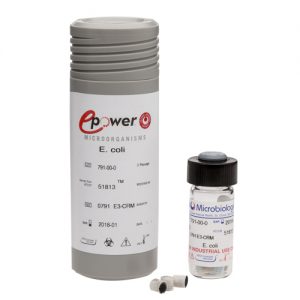 Certified Reference Material The ultimate in authenticity. Epower CRM quantitative quality control microorganisms, from Microbiologics®, are just one passage from the reference strain. If your lab is ISO 17025 accredited, Epower CRM can help you meet the requirements of Section 5.6.3.2 regarding reference materials. This product offers plenty of flexibility, which is a huge benefit in the lab. Each microorganism pellet has a pre-determined range of CFUs, so you can easily manipulate the product to deliver your desired concentration. You can also create a mixed microorganism population by combining multiple Epower CRM strains. As a Certified Reference Material, Epower CRM comes with a comprehensive Certificate of Analysis detailing the strains identity, characteristics and standard deviation. Applications & Test Methods
- ISO 17025 laboratories requiring CRM
- Detection and enumeration methods
- Verification/Validation
- Bioburden determination
- Minimal lethal concentration
- Disinfectant qualification
- Water tests
- Proficiency tests
- Methods requiring a specific CFU range
- Mixed microorganism population challenge
-
 Growth Promotion Testing EZ-Accu Shot, from Microbiologics®, provides a fast, convenient and reliable solution for Growth Promotion Testing, Media Challenge Testing and more. Each instant-dissolve microorganism pellet is designed to deliver 10-100 CFU per inoculum and provides 8 hours of stability after rehydration, so you can meet Pharmacopeia guidelines with ease. Applications & Test Methods
- Growth Promotion Testing
- Media Challenge Testing
- Suitability of Counting Methods
- Suitability of Sterility Tests
- Suitability of Tests for Specified Microorganisms
- Microbial Limits Testing
- Microbial Enumeration Testing
- Validation of Neutralization Methods
- Methods requiring a low CFU concentration
Call Us:IRL +353 (0)61-335844 / UK +44 (0)28 30833808